
Dental Bridges and Crowns in El Monte, CA — A Stronger, Healthier Smile Starts with the Right Restoration
When a tooth is damaged or missing, the right restoration can rebuild comfort, function, and confidence. Dr. Deisy Mon Morales takes time to explain your options so you can choose care that fits your smile and your priorities.
Dental Bridges and Crowns, A Stronger, Healthier Smile Starts with the Right Restoration
A missing tooth or a tooth that has lost much of its strength can make everyday activities feel less comfortable. You may begin chewing on one side, avoiding certain foods, covering your smile, or noticing that your bite no longer feels the same. Dental bridges and crowns address different problems, but both are designed to rebuild a smile with a restoration that remains in place.
United Dental Office provides restorative care at 11912 Valley Blvd Ste A, El Monte, CA 91732, in Plaza Del Valle near Mountain View Road and Garvey Avenue. Our Valley Boulevard office is convenient for patients traveling from South El Monte, Rosemead, Temple City, Baldwin Park, West Covina, and nearby San Gabriel Valley communities by way of the I-10 and I-605 corridors.
How Crowns and Bridges Restore Different Dental Problems
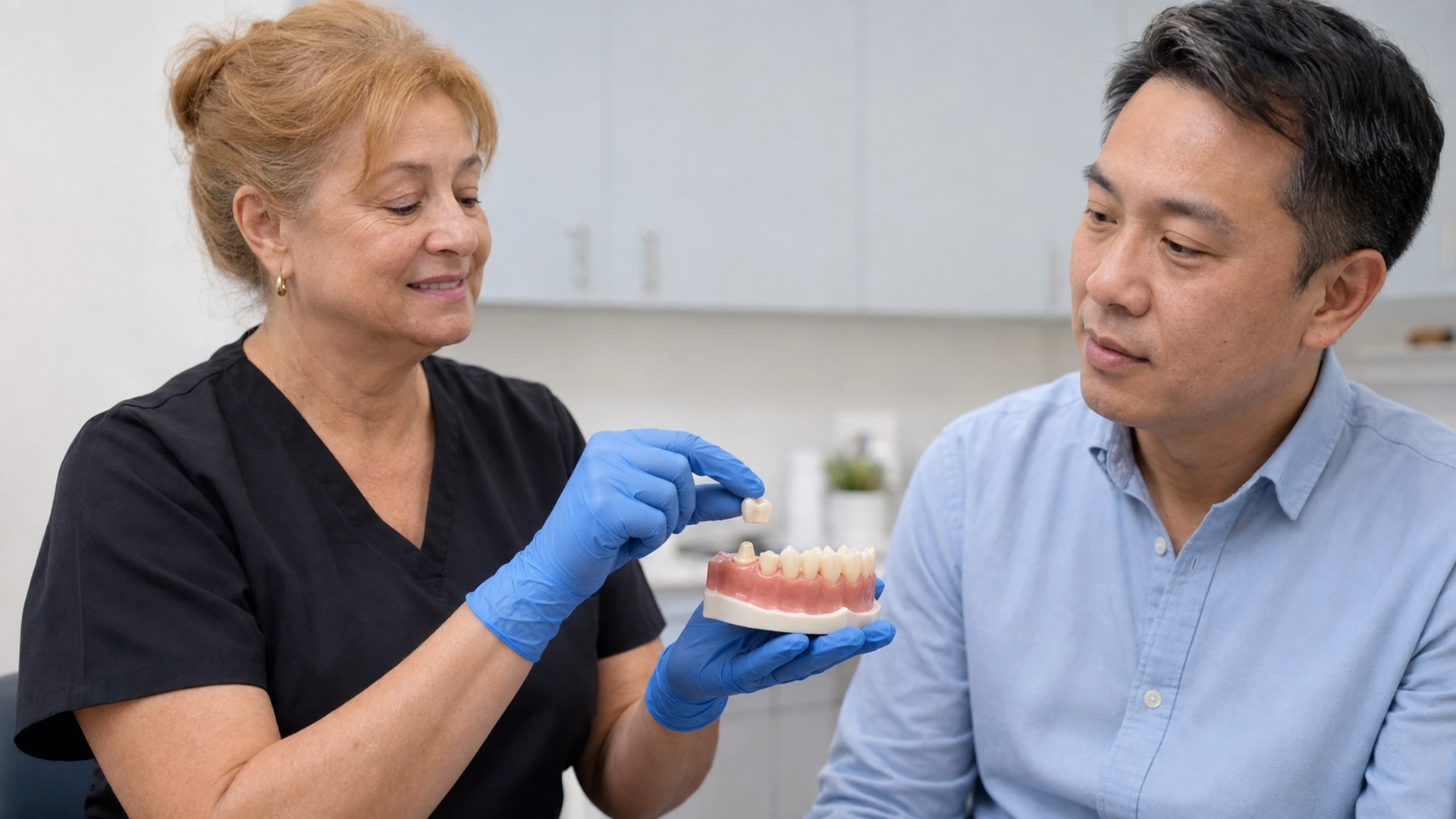
A dental crown covers an existing tooth. It is made to restore the tooth's shape, protect weakened structure, and provide a functional chewing surface. A crown may be considered when a filling alone cannot provide enough support or when a tooth needs more complete coverage.
A dental bridge fills an open space left by one or more missing teeth. A traditional bridge includes one or more replacement teeth, called pontics, connected to crowns that are supported by teeth beside the space. Once cemented, the restoration is fixed in the mouth and can only be removed by a dental professional.
In simple terms, a crown rebuilds a tooth that is still present, while a bridge replaces a tooth that is no longer there. An examination is necessary to determine which approach fits your oral health, bite, and long-term treatment needs.
When a Dental Crown May Be Recommended
Teeth absorb considerable pressure during biting and chewing. Decay, fractures, large fillings, wear, and previous treatment can reduce the amount of sound tooth structure available. A crown may be used to surround and protect the remaining tooth when a more conservative restoration is not appropriate.
Your dentist may discuss a crown if you have:
- A cracked, fractured, or significantly worn tooth
- A large cavity or filling with limited natural tooth structure remaining
- A tooth that needs protection after root canal treatment
- A broken or failing restoration
- A tooth whose shape or discoloration cannot be addressed with a simpler option
- A dental implant that requires its visible tooth-shaped restoration
- A neighboring tooth that will serve as an anchor for a traditional bridge
Not every damaged tooth can or should receive a crown. The tooth, root, supporting bone, gums, and bite must be evaluated before treatment is recommended.
When a Dental Bridge May Be Recommended
Leaving a space after tooth loss can affect more than the appearance of your smile. Depending on the location of the missing tooth, the space may interfere with chewing or speech. Nearby teeth may also move toward the opening over time, potentially changing the way the upper and lower teeth meet.
A fixed dental bridge may be worth considering when:
- One or more neighboring teeth are missing
- You prefer a restoration that does not need to be removed each day
- The teeth or implants intended to support the bridge are suitable for that role
- The open space is affecting chewing, speech, appearance, or bite stability
- You want to compare a bridge with an implant or removable tooth-replacement option
The health of the supporting teeth is especially important. If those teeth have decay, gum problems, insufficient structure, or inadequate bone support, they may require treatment first or a different replacement option may be more appropriate.
Crown and Bridge Materials
Crowns and bridges can be made from several dental materials. Tooth-colored options may include ceramic or porcelain-based restorations designed to coordinate with nearby teeth. Other situations may call for a metal alloy or a combination of materials because the visible appearance, amount of biting pressure, available space, and location in the mouth can all influence the choice.
The best material is not identical for every tooth. A restoration for a front tooth may place greater emphasis on translucency and shade matching, while a back tooth must tolerate different chewing forces. Your dentist can explain the advantages, limitations, appearance, and maintenance considerations of the materials appropriate for your case.
What to Expect When Receiving a Crown or Bridge
Treatment begins with a dental evaluation. The dentist examines the affected tooth or missing-tooth space, reviews the surrounding gums and bite, and may recommend X-rays or other records. Before moving forward, you should understand the diagnosis, available alternatives, expected sequence, and why a particular restoration is being proposed.
For a crown, the tooth is carefully shaped so the restoration can fit over it. For a traditional bridge, the supporting teeth are prepared to receive the connected crowns. Impressions or digital scans may then be taken to record the teeth and bite for the final restoration.
A temporary crown or bridge may be placed while the permanent restoration is being made. Because a temporary is not designed to serve as the final result, follow the care instructions you receive and contact the office if it becomes loose, breaks, or causes a change in your bite.
At the placement visit, the final restoration is evaluated for fit, contact with neighboring teeth, bite, comfort, and appearance before it is secured. The number of visits and exact steps can vary according to the tooth, restoration type, and any additional treatment needed.
Benefits of Rebuilding Damaged or Missing Teeth
Restorative treatment is intended to improve function while protecting oral health. Depending on your condition and the type of restoration selected, a crown or bridge may help:
- Reinforce a tooth that has become structurally weak
- Restore a more comfortable and useful chewing surface
- Replace a visible gap in the smile
- Support clearer speech when missing teeth have affected pronunciation
- Limit unwanted movement of teeth next to an open space
- Reestablish tooth shape, proportion, and alignment with nearby teeth
- Distribute biting forces more appropriately across the restored area
Results and longevity vary. The condition of the supporting teeth, bite forces, grinding or clenching, oral hygiene, diet, and regular dental care all affect how a restoration performs over time.
Choosing Between a Bridge and Other Tooth-Replacement Options
A bridge is one way to replace missing teeth, but it is not the only option. Dental implants and removable partial dentures may also be considered. Each approach has different requirements involving the neighboring teeth, gums, jawbone, treatment time, daily care, and overall cost.
A traditional bridge relies on prepared teeth on both sides of the gap. An implant-supported restoration relies on implants placed in the jaw and may avoid using adjacent natural teeth for support. A removable partial denture can replace several teeth and is taken out for cleaning. A personal evaluation allows the dentist to explain which alternatives are clinically suitable rather than assuming one solution is best for everyone.
Caring for Crowns and Bridges at Home
Crowns and bridges cannot develop cavities, but the natural teeth beneath or beside them remain vulnerable to decay and gum disease. Daily plaque removal is essential, especially along the edge where the restoration meets the tooth.
Brush twice a day with fluoride toothpaste and clean between your teeth every day. Floss threaders, interdental brushes, or a water flosser may help clean beneath a bridge pontic and around its supporting teeth. Your dental team can demonstrate the technique and recommend tools that fit your restoration.
Avoid chewing ice, opening packages with your teeth, or biting other hard objects that could damage either natural teeth or dental work. If you clench or grind, ask whether a protective appliance may be appropriate. Continue regular dental examinations so the restoration, supporting teeth, gums, and bite can be monitored.
Signs That a Crown or Bridge Needs Attention
Contact a dentist if a crown or bridge feels loose, moves, develops a rough or broken edge, traps food repeatedly, or changes the way your teeth meet. Pain, swelling, persistent sensitivity, bleeding around the restoration, an unpleasant taste, or difficulty chewing also deserves an evaluation.
Do not attempt to glue a loose restoration back into place with household adhesive. A dentist needs to determine whether the restoration can be recemented or whether the tooth, bridge support, or restoration itself requires additional care.
Comfortable Restorative Care Built Around Your Needs
Deciding how to repair a tooth or replace a missing one can feel complicated. Our approach is to explain what the examination shows, discuss reasonable alternatives, and answer your questions before treatment begins. Recommendations should account for your comfort, priorities, oral health, and the way the restoration will function as part of your complete bite.
No two damaged teeth or missing-tooth spaces are exactly alike. A personalized plan helps avoid unnecessary treatment and makes it easier to understand what can realistically be achieved.
Request a Dental Bridges and Crowns Consultation Near Plaza Del Valle
United Dental Office is located at 11912 Valley Blvd Ste A, El Monte, CA 91732, inside Plaza Del Valle near Mountain View Road, Garvey Avenue, and the Valley Boulevard corridor. The office is accessible from South El Monte, Rosemead, Temple City, Baldwin Park, West Covina, and other nearby San Gabriel Valley communities, with regional connections through the I-10 and I-605.
If you have a damaged tooth, an older restoration that concerns you, or a space left by a missing tooth, request an evaluation for dental bridges and crowns. The dental team can examine the area, explain whether a crown or bridge is appropriate, and help you compare the available restorative options.